In 2026, call centers have transcended beyond merely making and receiving calls. Call centers today manage calls, WhatsApp, chat, e-mail, SMS, social media interactions as well as AI-powered conversations all through one integrated platform. It is also easier for cloud contact center software to enable companies to scale up without having to invest in expensive hardware.
But there is no single “best” calling software for every call center.
A company handling sales calls needs a different system from one providing customer support, appointment booking, technical assistance or international BPO services. A hybrid call center will require a combination of inbound, outbound, and omni-channel functionalities.
It all depends on selecting the right software based on the kind of services offered, number of calls, agent process, and business objectives.
What Is Call Center Calling Software?
Call center software refers to the technology platform that enables agents to conduct outbound and inbound calling as well as enable management to manage calling operations.
Modern call center software has the capability to combine call functionalities with customer relationship management systems and other communication channels.
Depending on the platform, important features can include:
- Automatic call distribution (ACD)
- IVR
- Call recording
- Call queues
- Auto and power dialers
- Predictive and progressive dialing
- CRM integration
- Call monitoring
- Call analytics
- AI transcription and summaries
- Quality monitoring
- Omnichannel communication
- Workforce management
- Real-time dashboards
The right combination depends on what your agents actually do every day.
Different Types of Calling Software for Call Centers
1. Inbound Call Center Software
Inbound software is designed primarily for customers who call the business.
It can direct calls to the right department or agent via IVR and call routing rules.
Best for:
- Customer support
- Technical support
- Order status
- Complaint handling
- Help desks
- Appointment management
- After-sales service
Best choice: A cloud contact center with strong IVR, ACD, CRM integration, call recording and reporting.
2. Outbound Calling Software
The outbound system is specifically meant for agents who make outgoing calls to the clients or prospects.
- Lead generation
- Telemarketing
- Sales follow-ups
- Appointment setting
- Customer surveys
- Renewals
- Collections
- Win-back campaigns
Instead of agents manually entering every number, dialing software can automatically move through a campaign list.
However, the best dialing mode depends on the campaign.
3. Predictive Dialer
Predictive dialer is meant for heavy use in outbound campaigns.
It can dial multiple numbers while using algorithms to estimate agent availability and connect answered calls to available agents. This can significantly increase agent talk time when used appropriately.
Best for:
- Large sales campaigns
- Lead-generation campaigns
- High-volume B2C calling
- Large outbound teams
Advantage
Agents spend less time listening to unanswered calls and more time speaking with customers.
Important consideration
Predictive dialing requires careful campaign management, appropriate team size and compliance controls. It is not automatically the best choice for a small team or every type of customer call.
4. Progressive Dialer
A progressive dialer provides a more controlled approach.
It generally waits until an agent is available and then places the next call, rather than dialing ahead aggressively.
Best for:
- Customer follow-ups
- Renewals
- Service calls
- Compliance-sensitive campaigns
- Medium-sized outbound teams
It offers a useful balance between agent productivity and control.
For those firms where each interaction with the client needs careful handling, progressive dialing may be a better choice than making many calls.
5. Power Dialer
A power dialer is an automated tool that takes the agent from one contact to another on a list.
Best for:
- Sales representatives
- B2B lead follow-up
- Small and medium sales teams
- Callback campaigns
- Agents who need some control over each conversation
A power dialer can be particularly useful when the agent needs to review information or add notes between call.
6. Preview Dialer
A preview dialer gives the agent information about the customer before the call is placed.
This is valuable when a conversation requires preparation.
For example, an agent might see:
- Customer name
- Previous conversations
- Purchase history
- Previous complaints
- Lead source
- Notes from another agent
Best for:
- B2B sales
- High-value leads
- Customer retention
- Complex technical support
- Financial or professional services
Here, quality of conversation is more important than simply increasing the number of calls.
7. Omnichannel Contact Center Software
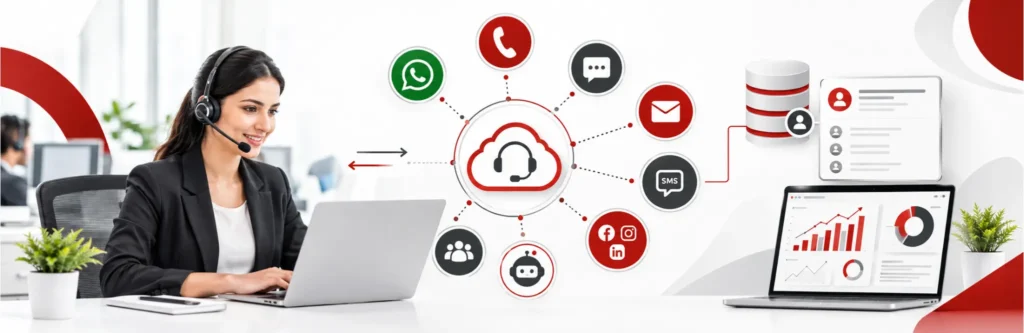
Omnichannel technology brings various customer communication channels together on a single platform.
Best for:
- E-commerce
- SaaS companies
- Online businesses
- Large customer-support operations
- International BPOs
- Brands with multiple customer touchpoints
For example:
Customer sends WhatsApp message → continues through chat → calls support → agent sees previous interaction.
This creates a more connected customer experience.
8. AI-Powered Call Center Software
AI plays an increasingly vital role in modern contact centers.
AI can support functions such as:
- Call transcription
- Automatic call summaries
- Sentiment analysis
- Agent assistance
- Intelligent routing
- Quality monitoring
- Customer self-service
- Automated responses
- Knowledge suggestions
Modern AI contact-center platforms can combine voice and digital channels.
Best for:
- Large contact centers
- High call volumes
- Customer-support operations
- Technical support
- Companies wanting stronger quality monitoring
- Businesses looking to reduce repetitive work
Modern AI-enabled contact center platforms can integrate both voice and digital channels, along with AI-powered routing and agent assistance.
9. Cloud-Based Call Center Software
Cloud software has become an important option because businesses can operate their contact centers without maintaining traditional on-premise telephone infrastructure.
Agents can work from offices, branches or approved remote locations while connecting to the same cloud platform.
Best for:
- Startups
- Growing businesses
- BPOs
- Distributed teams
- Hybrid workplaces
- Companies opening new locations
Cloud contact centers can also scale more easily when the number of agents changes.
Which Software Is Best for Which Call Center?
| Call Center Service | Recommended Software |
| Customer support | Inbound + ACD + IVR + CRM |
| Technical support | Inbound + CRM + recording + AI assistance |
| Lead generation | Progressive or predictive dialer |
| High-volume telemarketing | Predictive or progressive dialer |
| B2B sales | Power or preview dialer + CRM |
| Appointment setting | Progressive/Power dialer + CRM |
| Customer retention | Preview/Progressive + customer history |
| E-commerce support | Omnichannel + inbound + CRM |
| International BPO | Cloud + omnichannel + analytics |
| Remote call center | Cloud contact center |
| Large enterprise | CCaaS + AI + WFM + analytics |
| Hybrid sales & support | Omnichannel + inbound + outbound dialer |
What About a Hybrid Call Center?
For many businesses, a hybrid solution is actually the best choice.
A hybrid call center may receive customer calls while simultaneously making outbound sales or follow-up calls.
For example:
Inbound team
→ Customer support
→ Order enquiries
→ Complaints
Outbound team
→ Lead generation
→ Sales follow-up
→ Appointment setting
Digital team
→ WhatsApp
→ Chat
→ Email
All three can operate through an integrated contact-center platform.
This means the company doesn’t have to choose between “inbound software” and “outbound software.” It can select a platform that supports both workflows.
How to Select the Best Calling Software in 2026
Before purchasing software, businesses should ask five important questions.
1. What type of calls do we handle?
Are you mainly:
- Receiving calls?
- Making calls?
- Doing both?
- Handling chat and email too?
Start with your actual workflow rather than the software’s feature list.
2. How important is call volume?
If your objective is to make a very large number of outbound calls, consider dialer technology.
If every conversation requires research and preparation, a preview or progressive approach may be better.
3. Can it integrate with your CRM?
CRM integration is essential for many modern call centers.
Agents should ideally be able to see customer information without repeatedly switching between different applications.
Features to Look for in Call Center Software
A good 2026 solution should be evaluated on more than its dialing capability.
Look for:
Core calling
- IVR
- ACD
- Call queues
- Call recording
- Call transfer
- Call monitoring
Outbound
Power dialer
Progressive dialer
Predictive dialer where appropriate
Campaign management
Callback scheduling
Customer experience
CRM integration
Customer history
Omnichannel communication
Self-service options
Management
Real-time dashboards
Agent performance reports
Quality monitoring
Workforce management
AI
Transcription
Call summaries
Sentiment analysis
Agent assistance
Automated quality checks
Security and compliance
Access controls
Data protection
Recording controls
Appropriate regulatory compliance for the markets served
The Best Approach: Choose by Service, Not by Software Name
There is no universal winner when it comes to call center software.
A lead-generation company may benefit most from a powerful outbound dialer.
A customer-support company may need inbound routing, CRM integration and omni-channel communication.
A BPO may need a flexible cloud platform supporting multiple clients, campaigns and reporting structures.
A large enterprise may benefit from advanced AI, workforce management and quality analytics.
And a company handling both sales and customer service may be better served by a hybrid omni-channel contact-center platform.
The smartest approach in 2026 is therefore not to ask, “Which is the best calling software?”
Instead, ask:
“Which calling technology best matches our customers, agents, call volume and service model?”
Once that question is answered, choosing between inbound software, power dialing, progressive dialing, predictive dialing, preview dialing, AI platforms or a complete omnichannel saas solution becomes much easier.
FAQs
1. What is the best cloud calling solution for call centers?
A cloud calling solution which offers CRM integration, IVR, call recording, and either a power or progressive dialer, would be a good starting point. At this stage, focus on how easy to use a solution is and how well it scales rather than buying a lot of fancy features.
2. Is predictive dialing the right choice for every outbound call center?
Predictive dialing works best for high volume operations. Smaller operations, or even smaller campaigns that require higher customization and personalization may be better off with progressive, power or preview dialing.
3. Which software is considered the most suitable for hybrid call center functioning?
An omni-channel cloud contact center with features such as inbound routing capability, outbound dialing capability, CRM integration, recording and analytical options is typically regarded as the best one for hybrid call center operations done by combining both models mentioned.
4. Should call centers opt for cloud software?
Compared to other types of software, the software using cloud systems can ensure the process of scaling easier for many end-users and the possibility of not requiring establishing the same level of infrastructural systems for hybrid and distributed teams in use on a daily basis.
5. Is the use of AI important in call center software by 2026?
Despite the fact that applying artificial intelligence is not a necessity for running call centers, it may still be of great help when it comes to tasks referring to transcribing, making the summaries, support of the agents, routing, quality control, and providing means for customer self-service.