
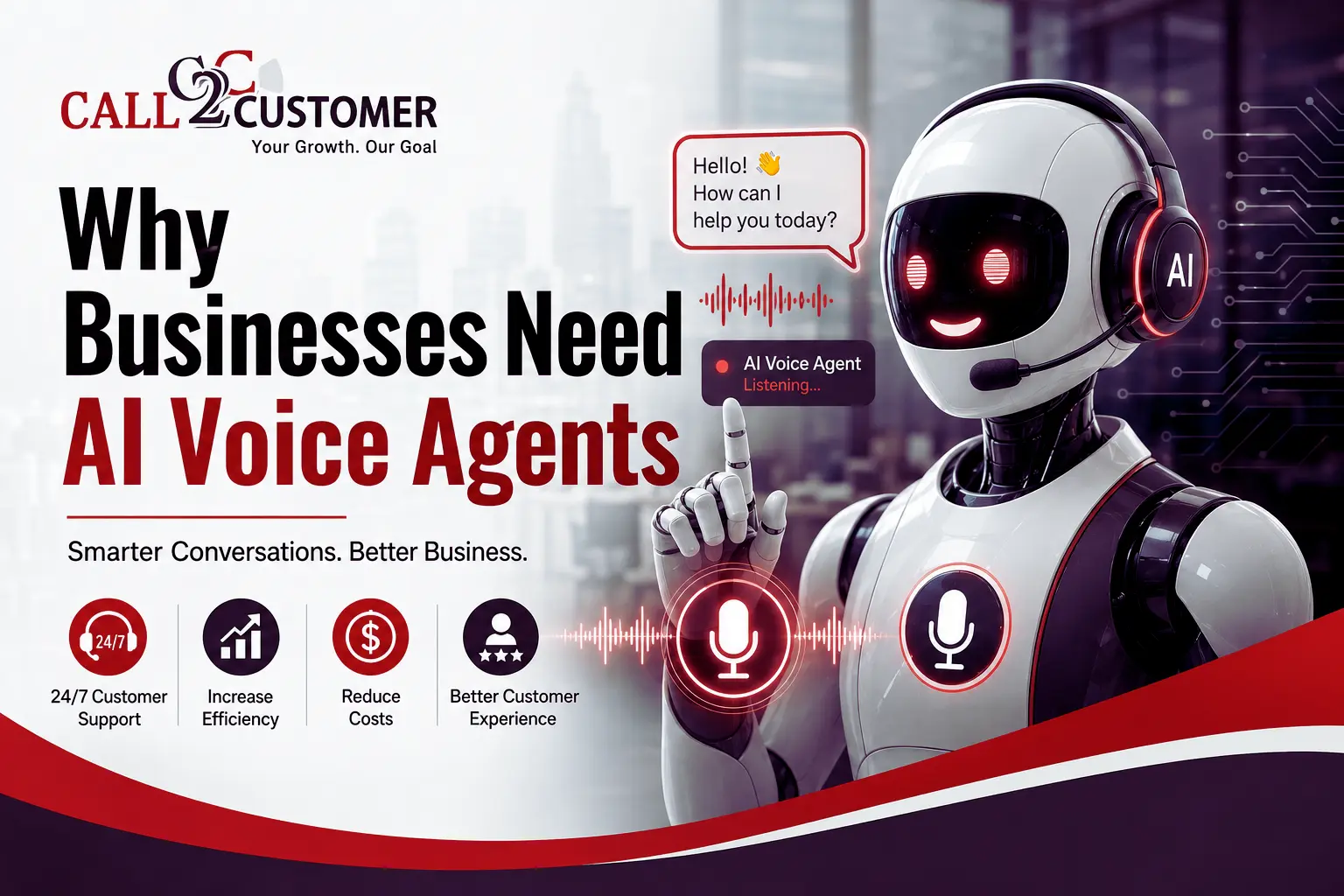
AI Voice agents have become a vital tool in customer services today. It is a software program that can engage in conversation with customers using a natural voice.
It can do multiple tasks to assist call center agents when needed. These tasks are:
Understands customer speech
Responds appropriately
Collects information
Answers frequently asked questions
Schedules appointments
Gives updates
Transfers difficult conversations
In case a business deals with a lot of customer calls, it improves efficiency while offering better customer engagement.
What Is an AI Voice Agent?
An AI-driven virtual assistant is a system that interacts with customers via telephone. While traditional call centers use automatic phone systems that primarily rely on fixed menus like “Press 1 for sales and Press 2 for support,” modern AI voice agents are capable of processing human speech and reacting to what is being said.
Depending on the business requirements, an AI voice agent can:
Answer incoming customer calls
Make outbound calls
Answer frequently asked questions
Qualify leads
Schedule appointments
Confirm orders
Provide order or delivery updates
Collect customer information
Conduct surveys
Send reminders
Route calls to the appropriate department
Transfer complicated issues to human agents
Why Do Businesses Need AI Voice Agents?
1. 24/7 Customer Support
Customers may call businesses at non-standard hours. In this case, an AI assistant can help customers to answer standard questions even after office hours. When there are no human agents available, it is able to record customer queries and schedule callback.
2. Handle High Call Volumes
Businesses can receive huge numbers of calls during peak hours.
A large call volume can lead to:
- Long waiting times
- Missed calls
- Abandoned calls
- Overloaded customer service teams
- Delayed responses
It can handle many routine conversations simultaneously, which reduces the pressure on human agents. It helps them to focus on conversations that required dealing with empathy. That conversation that needs negotiation or decision-making are taken care by call center agents.
3. Improve Response Time
Customers are not fond of waiting for simple responses.
The AI voice bot can immediately respond to most routine requests without placing customers on hold or waiting for an available employee to get back to them.
Quick responses will make it easier for customers to communicate and also for organizations to manage their queries more efficiently.
4. Support Outbound Calling
AI voice agents are not limited to answering incoming calls.
They can also support outbound calling campaigns such as:
- Lead qualification
- Appointment reminders
- Customer follow-ups
- Payment reminders
- Feedback surveys
- Event confirmations
- Order confirmations
- Customer reactivation campaigns
For businesses that make a large number of routine outbound calls, this can reduce the amount of repetitive calling handled manually by employees.
Traditional IVR systems usually guide customers through predefined menus.
For example:
“Press 1 for Sales. Press 2 for Support. Press 3 for Billing.”
This approach can work for simple call routing, but customers may find complicated menu systems frustrating.
AI voice agents can allow customers to describe their requirements naturally.
5. Improve Employee Productivity
AI voice agents should not necessarily be viewed as replacements for human employees.
Instead, they can work alongside customer service teams.
AI can manage routine and repetitive conversations, while human agents handle:
- Complex complaints
- Sensitive situations
- Negotiations
- High-value customers
- Technical problems
- Situations requiring human judgment
Human + AI customer service model helps in increasing efficiency as technology handles routine workload and employees focus on higher-value interactions.
6. Consistent Customer Service
Human agents may handle similar questions differently depending on workload, experience, or circumstances.
An AI voice agent follows configured processes consistently.
For routine enquiries, this can help businesses maintain a standard approach to:
- Frequently asked questions
- Appointment scheduling
- Order updates
- Basic troubleshooting
- Information collection
- Call routing
Organizations can also update the information about what the AI voice agent should know and how to handle various processes as they update their products/services/policies.
7. Provide Useful Call Data and Insights
AI voice systems can generate valuable information about customer interactions, depending on the system’s capabilities and configuration.
Businesses may analyse:
- Common customer questions
- Call reasons
- Frequently reported problems
- Peak calling periods
- Customer feedback
- Lead quality
- Call outcomes
These insights can help businesses identify recurring customer problems and improve their products, processes, and customer service strategies.
8. Scale Customer Support More Easily
As a business grows, its customer support requirements usually grow as well.
Hiring and training additional employees takes time and resources.
AI voice agents can help businesses manage additional routine call volume without increasing human staffing at exactly the same rate.
This can be particularly useful during:
- Seasonal sales
- Product launches
- Promotional campaigns
- Holiday periods
- Sudden increases in enquiries
The Future of Customer Service Is Human + AI
The AI voice agent is transforming the way that organizations are dealing with customer queries on phones. It can help organizations in routine queries, marketing campaigns, and quick responses.
Yet, the most optimal solution is not necessarily replacing humans with machines.
The best solution is to use AI for the routine and human agents for complex inquiries.
With proper technology implementation, integration, security, and escalation to human agents, AI voice agents can be a crucial tool in today’s customer service operations.
Conclusion
AI voice agents are needed in business because customers demand rapid and convenient interaction while businesses require handling large call volumes effectively.
The use of AI systems ranges from round-the-clock customer interaction, customer leads generation, scheduling appointments, and customer follow-up calls to those situations in which the use of humans is essential.
If your business wants to take advantage of the benefits of a modern contact center, then the combination of AI voice agents and human agents is a good approach.
FAQs
1. What is an AI voice agent?
An AI system can talk to customers over phone calls. It can respond to customer questions, make appointments, and handle complicated phone calls by transferring them to human agents.
2. How can AI voice agents be useful for businesses?
AI systems can provide round-the-clock customer assistance and manage many phone calls. Repetitive tasks can be minimized with AI systems, and hence the response time will be fastened.
3. Can AI voice agents make outbound calls?
Yes. They can make outbound calls for the services to handle routine business activities like
o Lead qualification,
o Appointment reminders,
o Customer follow-ups,
o Surveys, and
4. Can an AI voice agent replace human customer service agents?
It is generally most useful when working alongside human agents. They can handle routine conversations, while human employees manage complex, or sensitive to provide high-value customer interactions.
5. Can AI voice agents integrate with CRM and business systems?
Yes. Depending on the technology and setup, they can integrate with CRM. They can be integrated with system to do various tasks like scheduling, and order-management to access relevant information. It also automates workflows.